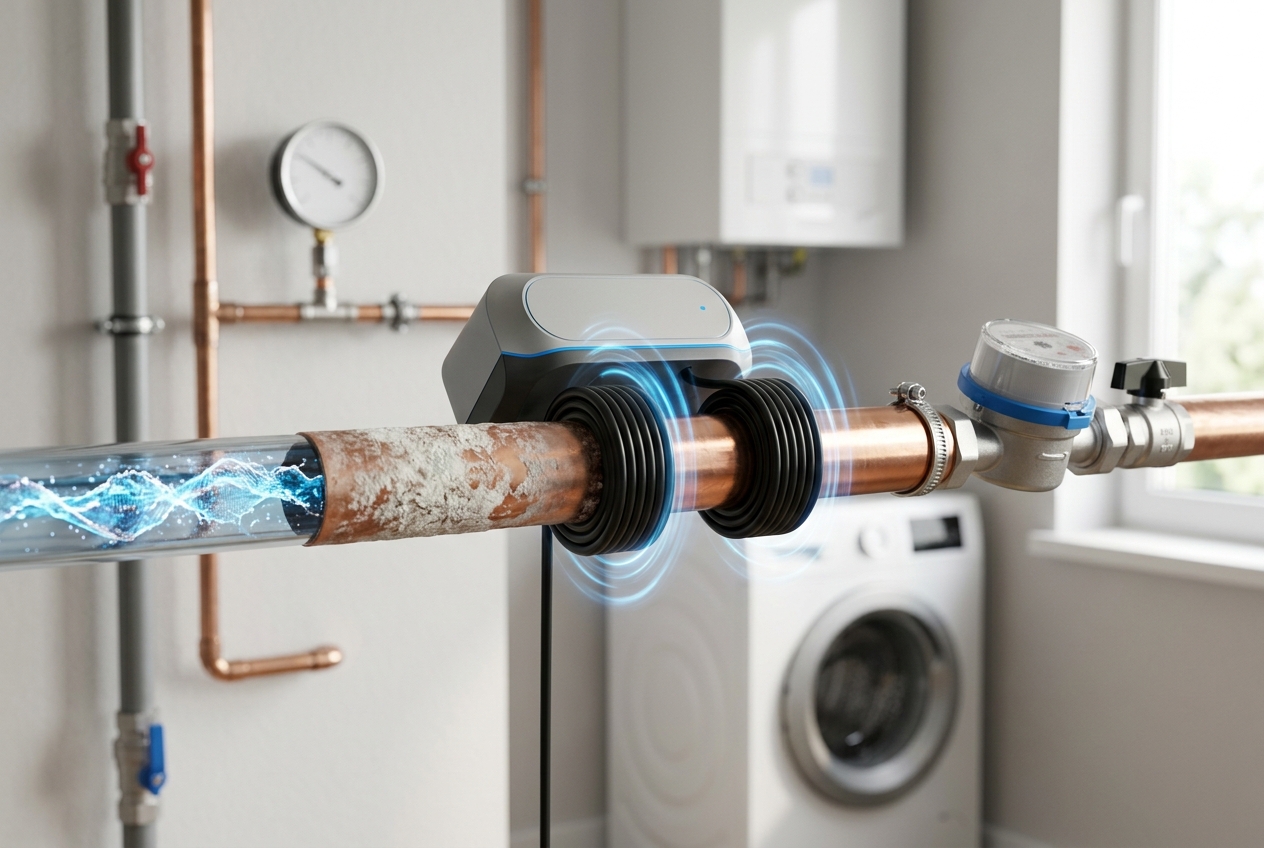
Frequency induction technology achieves chemical free limescale removal by wrapping a coil around your main water pipe and passing a high-frequency electric field through it. This field alters how dissolved calcium and magnesium crystallise, so instead of hard scale that sticks to pipes and appliances, minerals form loose particles that flush away with the water — no salt, no chemicals, no plumbing changes.
Limescale is one of the most common household frustrations in hard-water regions. It clogs showerheads, dulls glassware, coats kettle elements and shortens the life of washing machines and boilers. Aquanity, an Israeli company specialising in chemical-free water softening, builds its devices around this induction principle — and below we break down exactly how the physics works, why it needs no consumables, and what results you can realistically expect.

What Is Frequency Induction Technology and How Does It Work?
Frequency induction technology uses a radio-frequency alternating electric field to influence the minerals in your water without adding or removing anything. A coil clamps onto the outside of the incoming pipe and emits a carefully tuned signal. As water passes through the field, the natural crystallisation behaviour of dissolved calcium carbonate changes.
In laboratory work on this method, an RFAEF inductance device study described a unit operating at 12V that induces a 300V electric field at a frequency of 750 kHz. The low input voltage matters for households — the device is safe to run continuously and consumes very little power.
The key point is that no minerals are stripped out. The water keeps its natural calcium and magnesium content — and their health benefits and taste — while losing the ability to cement itself onto surfaces.
How does the electric field stop scale from forming?
Hard scale forms when calcium carbonate crystallises in its sticky calcite form directly on hot surfaces. The alternating field encourages the mineral to seed as suspended particles in the water instead. These float harmlessly through pipes and drain away, so new scale struggles to bond. Over time, water low in adhesion also begins lifting existing deposits.
Why Choose Chemical Free Limescale Removal Over Traditional Methods?
Conventional descaling relies on either strong acids or salt-based ion-exchange softeners. Both work, but both carry drawbacks that frequency induction avoids entirely.
- No salt bags to buy or lift. Salt softeners need regular refills and regeneration cycles that flush brine into the drain.
- No acids or harsh cleaners. Chemical descalers can damage seals, etch chrome and are hazardous to handle and store.
- No consumables. Once installed, an induction device runs on electricity alone — an overview of electronic water treatment notes that these systems offer around 50% scale reduction with no consumables, referencing an ASU/WateReuse 2011 study.
- Minerals stay in your water. Unlike ion exchange, nothing is removed, so the water still tastes natural.
For households that want an easy, maintenance-light approach, the appeal is obvious: install once and forget it. This is exactly the philosophy behind the Aquanity Eco Water Solution range, which is designed for a one-step fit without a plumber.

How Effective Is Frequency Induction at Removing Limescale?
Effectiveness depends on water hardness, flow rate and how the device is positioned, but the physical treatment approach has been measured repeatedly in research settings.
Studies on physical water treatment using radio-frequency electric fields have reported meaningful results. A peer-reviewed study on RF electric field treatment found scale thickness reductions where fouling resistance dropped by more than 58%. Separately, the ASU/WateReuse 2011 work cited above measured around 50% scale reduction with no consumables required.
In practical household terms, users typically notice these changes first:
- Kettle elements and showerheads staying cleaner for longer.
- Less chalky residue on glassware and taps.
- Softer-feeling water and improved lathering with soap.
- Existing scale loosening gradually over the following weeks.
How long does it take to see results?
Frequency induction is a preventative and gradual process, not an instant scrub. New scale is inhibited from the moment the device is switched on, but visible improvement on already-scaled surfaces usually appears over four to eight weeks as treated water slowly lifts old deposits.
What Does Hard Water Really Cost You in Israel?
Beyond the visible mess, limescale quietly raises running costs. Scale acts as an insulating layer on heating elements, forcing boilers and kettles to work harder to reach the same temperature — which means higher electricity bills and shorter appliance lifespans.
Water itself is not cheap either. According to an AliyahPro guide to water service in Israel, household water is billed at roughly ₪7.533 per cubic metre before VAT. When scale reduces the efficiency of your hot-water system, you effectively pay more for every heated litre.
A chemical-free approach addresses the source of the problem — the mineral behaviour — rather than repeatedly buying descaling products to treat the symptoms.
Which appliances suffer most from limescale?
Anything that heats water is at highest risk: electric kettles, boilers, dishwashers, washing machines and coffee machines. Showerheads and taps show cosmetic scaling first, but the expensive damage happens inside sealed heating systems where you cannot see it.
Installing a Frequency Induction Device: What to Expect
One of the biggest advantages of this technology is how simple installation is. Because the coil works on the outside of the pipe, there is no cutting, no soldering and no need to shut off your mains for long.
A typical fit follows these steps:
- Choose the location. Position the device on the main incoming cold-water pipe, ideally close to where water enters the home.
- Wrap the coil. Wind the induction wire around the pipe as instructed — this takes minutes and needs no tools.
- Power it on. Plug the unit into a nearby socket. It begins emitting the treatment field immediately.
- Leave it running. The device operates continuously and silently, with no maintenance or refills.
This plug-and-play design is what makes the Aquanity solution suitable for renters and homeowners alike — nothing about your plumbing is altered.
Frequently Asked Questions
Does frequency induction remove minerals from my water?
No. Unlike salt-based softeners, it leaves calcium and magnesium in the water. It only changes how those minerals crystallise, so they no longer stick as hard scale, meaning you keep the natural taste and mineral content of your tap water.
Is chemical free limescale removal safe for drinking water?
Yes. The technology adds nothing to the water and takes nothing out. It applies an external electric field to the pipe, so the water composition stays exactly as your utility delivers it, which is why no chemicals or salt are involved.
How much scale reduction can I actually expect?
Research on physical RF electric field treatment recorded fouling resistance reductions of more than 58%, while a 2011 ASU/WateReuse study measured around 50% scale reduction. Real household results vary with water hardness and flow, but a clear drop in new scale is typical.
Will it work on limescale that is already there?
It is primarily preventative, stopping new scale from bonding. Over several weeks the treated water tends to loosen existing deposits gradually, so older scale on kettles, showerheads and taps becomes easier to wipe away over time.
Do I need a plumber to install it?
No. The coil wraps around the outside of your main pipe and the unit plugs into a standard socket. There is no cutting or soldering, so most people fit it themselves in a few minutes without any technical knowledge.
How much electricity does the device use?
Very little. Laboratory versions of this technology run on just 12V to generate the treatment field, so a household unit draws minimal power even when left on permanently, adding a negligible amount to your electricity bill.
Ready to stop fighting limescale with acids and salt bags? Explore the chemical-free water softening range from Aquanity Eco Water Solution and enjoy cleaner appliances, softer water and better-tasting tap water with a single, simple installation.